
You've probably heard the term "mood diary" and had a rough idea of what it involves. Something to do with writing down how you feel. Maybe something a therapist suggested, or a habit you've seen mentioned alongside mindfulness and journalling.
But the specifics are less obvious. What do you actually write? How often? And does it do anything useful, or is it just another habit that sounds good in theory and quietly disappears after two weeks?
This is a plain-English answer to those questions.
What a mood diary actually is
A mood diary (sometimes called a mood journal or mood tracker) is a record of how you feel, made consistently over time. That's it.
The format varies. Some people keep a paper notebook. Others use a dedicated app, a spreadsheet, or a simple daily note on their phone. The terminology varies too: "mood diary," "mood journal," and "mood tracking diary" are all used interchangeably. If you've heard one term and not another, you haven't missed a distinction: they describe the same thing.
What makes something a mood diary rather than a regular diary is the focus. You're recording your emotional state, not the events of your day. Most entries are short: a rating, a word or two, sometimes a brief note. Unlike a journal, which tends to be exploratory and open-ended, a mood diary is structured and quick.
The one thing that matters more than format is consistency. A mood diary kept sporadically tells you very little. Kept regularly, even imperfectly, it becomes genuinely informative.
What you actually record
Most people overthink this, and then don't start at all.
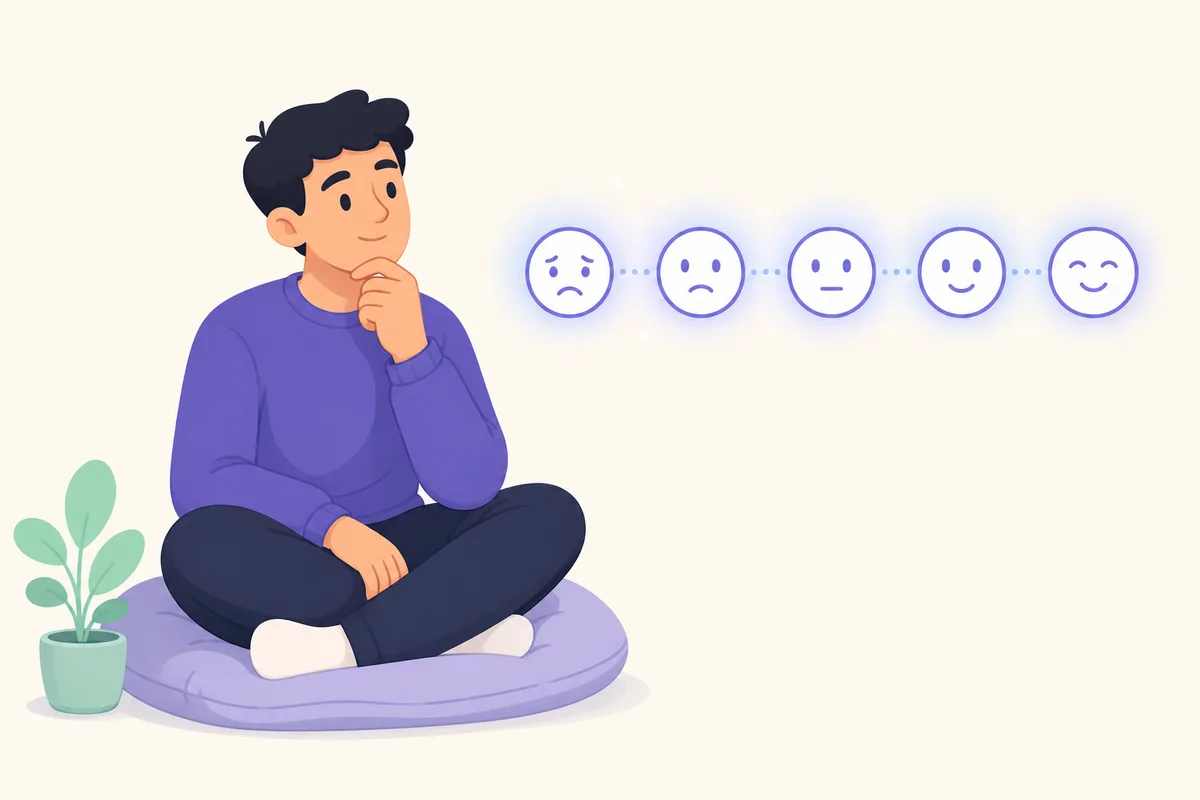
The minimum useful entry is a mood rating and nothing else. Many people use a simple scale: five points, ten points, or just a handful of descriptive words, logged once a day. Something like: rough / not great / okay / good / great. That's enough to start building a picture.
The reason simple formats work better than detailed ones isn't laziness. It's that complexity creates friction, and friction kills consistency. When you ask yourself to write a detailed account of your emotional state every day, it quickly starts to feel like homework. You start skipping days. The log becomes patchy, then abandoned.
There's also a real phenomenon of tracking fatigue: the more detail a logging system demands, the harder it becomes to sustain. A single daily rating takes five seconds. A structured reflection on triggers, intensity, context, and physical symptoms takes five minutes, and after a few weeks, many people find they simply can't face it.
A short optional note alongside your rating can add useful context. Tired today. Difficult conversation at work. Good walk this morning. Notes like these help you understand patterns when you look back. But they should feel optional, not obligatory.
What a mood diary shows you over time
The most common thing people say when they've kept a mood diary for a few months is that they couldn't have reconstructed that picture from memory alone.
Human memory for emotional experience is unreliable in a specific way: the bad times and the good times tend to flatten out. When you're in a difficult period, it can feel like it's always been this way. When things are better, it's hard to remember how rough the low point actually was. Trying to assess your emotional history from memory alone is a bit like navigating with a map you drew from recall: roughly right in places, distorted in others.
A mood log gives you the actual record. And what tends to emerge from that record are patterns: days of the week that are consistently harder; periods that reliably improve or worsen; the slow improvement over months that's invisible week-to-week but clear when you look at the whole span.
It also gives you evidence. Not proof of cause-and-effect. A mood diary is an observation tool, not a diagnostic one. But seeing that your mood has been improving, even gradually, is a different experience from trying to feel whether it has. The log makes visible what memory obscures.
How long before you start seeing anything useful? It varies. If your mood is relatively stable, a few weeks will show you patterns. If you're going through a significant life change (a loss, a period of recovery, a major transition), you may need months before the broader shape becomes clear. The longer the record, the more it tells you.
What the research says
Research on mood tracking is honest in a useful way: it's not a treatment, and the evidence that it directly improves mood symptoms is weak. A 2026 systematic review and meta-analysis published in JMIR Mental Health, covering people with depression and bipolar disorder, found that mood monitoring interventions do not reliably increase or decrease mood symptoms in those clinical populations.
That might sound like a reason not to bother, but it's actually an important clarification. A mood diary isn't a therapeutic intervention. It doesn't fix anything. What the research does support is the self-awareness benefit: knowing more about your own emotional patterns. A 2025 qualitative study in JMIR mHealth and uHealth found that regular emotional check-ins via app supported "enhanced emotional self-awareness and regulation in daily life" among participants.
There's also an honest caveat. A 2025 systematic review in npj Digital Medicine found that some people experience negative effects from mood monitoring: increased rumination, becoming preoccupied with tracking, or finding the daily reminder of their emotional state an unwelcome burden. These effects appeared more often in clinical populations using high-frequency tracking (multiple check-ins per day), and were often described as temporary. They're worth knowing about.
The practical implication: if daily emotional check-ins make you feel more anxious rather than less, that's a real signal. Not everyone benefits from self-monitoring in the same way.
Who a mood diary is useful for, and who it probably isn't
A mood diary can be useful for almost anyone who is curious about their emotional patterns and is prepared to stick with it. You don't need to be struggling. Many people find it useful simply as a way of staying attentive to how they feel over time, especially during busy or pressured periods when it's easy to lose track of yourself.
It tends to be particularly valuable for:
- People going through a period of change or difficulty: recovery, transition, grief, high stress. The log becomes a record of progress that's visible even when it doesn't feel that way.
- People in therapy or working with a GP on emotional wellbeing: concrete data is more useful to a clinician than "I've been feeling quite low lately." A month of mood ratings gives them something to work with.
- People who are trying to understand what affects their mood: sleep, exercise, social contact, work patterns. A diary makes correlations visible that might otherwise go unnoticed.
It's less useful for:
- People who find self-monitoring increases anxiety: if checking in with how you feel tends to amplify rather than settle your emotional state, a daily prompt may not help you.
- People who want immediate insight: patterns take time to emerge. If you're looking for clear answers after a week, you'll be disappointed.
- People who struggle with consistency: a patchy log is significantly less useful than a regular one. If you need an external prompt to keep going, a daily reminder (from an app or a bot) can help.
A mood diary is not appropriate as a substitute for professional support. If you're experiencing significant mental health difficulties, a log can complement support but not replace it.
How digital tools changed this
Paper mood diaries work, but they have one practical problem: you need pen and paper to hand, at the time you want to log. Most people are inconsistent with them. Not because they've lost interest, but because the habit doesn't have enough structure to sustain itself.
Apps and digital tools changed this in a straightforward way: a daily prompt at a fixed time removes the friction of remembering. You get a notification, you log your mood, you're done. No setup, no blank page.
Some tools take this further: mymood sends one Telegram message a day at a time you choose. You pick from five mood options (Rough, Not great, Okay, Good, Great), add an optional note if you want one, and that's your check-in done. The whole thing takes under fifteen seconds. It's not the only way to keep a mood diary, but it's one of the lower-friction options available, particularly if you're already using Telegram.
Frequently asked questions
How often should I write in a mood diary?
Once a day is the standard recommendation and, for most people, the right amount. More frequent check-ins (several times a day) can give a more granular picture but also carry a higher dropout rate and, in some research, increase the burden of self-monitoring. Once daily, at roughly the same time each day, is both sustainable and informative.
What if I miss a day?
Skip it and carry on. Don't backfill with a guess. A missing entry is just missing data; a fabricated one is noise. Mood diaries with occasional gaps are still useful. What makes them less useful is abandoning them after a missed day.
Do I need to write a lot?
No. A single word or rating is a valid entry. The most useful diaries aren't the most detailed. They're the most consistent.
Is a mood diary the same as a mood tracker?
Effectively, yes. "Mood tracker" tends to refer to digital tools that log and display your data; "mood diary" or "mood journal" implies something slightly more personal, sometimes with written notes. In practice, the terms overlap and the distinction isn't meaningful.
The bottom line
A mood diary is a record of how you feel over time. It won't improve your mood by itself. The research is clear that mood tracking isn't a treatment. But it does something that's genuinely difficult to do any other way: it gives you an honest, accurate picture of your own emotional history.
If you're in a difficult period, that picture can show you progress you might not otherwise see. If you're generally fine, it can surface patterns: what lifts you, what depletes you, that are hard to notice in the moment.
It works best when it's simple, consistent, and honest. And it takes about as long each day as brushing your teeth.
If you want to start, start small. A word a day. Add a note when you feel like it. Give it a month before you look for patterns.